

The Perfect Farewell
Day 9 • Auckland → Tiritiri Matangi → Auckland
Quest Overview
Riding rental scooters to and from the Auckland ferry terminal Spotting a great white shark fin during the crossing Exploring Tiritiri Matangi on a long loop around the island
Table of Contents
The Last Full Day
The strange thing about the final day of a great trip is that you know it is the final day before it begins.
Every trail, ferry ride, photograph, and meal carries a little more weight because there is no longer another open day waiting behind it.
This was officially Day 9 of the expedition. Day 0 had stretched across two calendar days as we crossed the Pacific and lost December 1 to the International Date Line. Now, on December 10, we had one full day left before flying home the next morning—and New Zealand somehow saved one of its fullest experiences for the end.
We had come because the stars aligned: an incredible flight deal, our adult nephew living at home and able to help with the kids, two fortieth birthdays in the same milestone year, and an anniversary worth celebrating even if the timing was very late.
The adventure had been fast, enormous, and almost impossible to process. But it did not feel unfinished. It felt like the final chapter had arrived exactly when it should.
Scooters to the Ferry
By this point we had crossed New Zealand by plane, rental car, coach, ferry, water taxi, kayak, and overnight ship. Naturally, the final full day began by adding electric scooters.
We rented them near the hotel, rode through central Auckland to the waterfront, and left them near the ferry terminal. It was practical, fun, and perfectly consistent with a trip where movement had become part of the adventure.
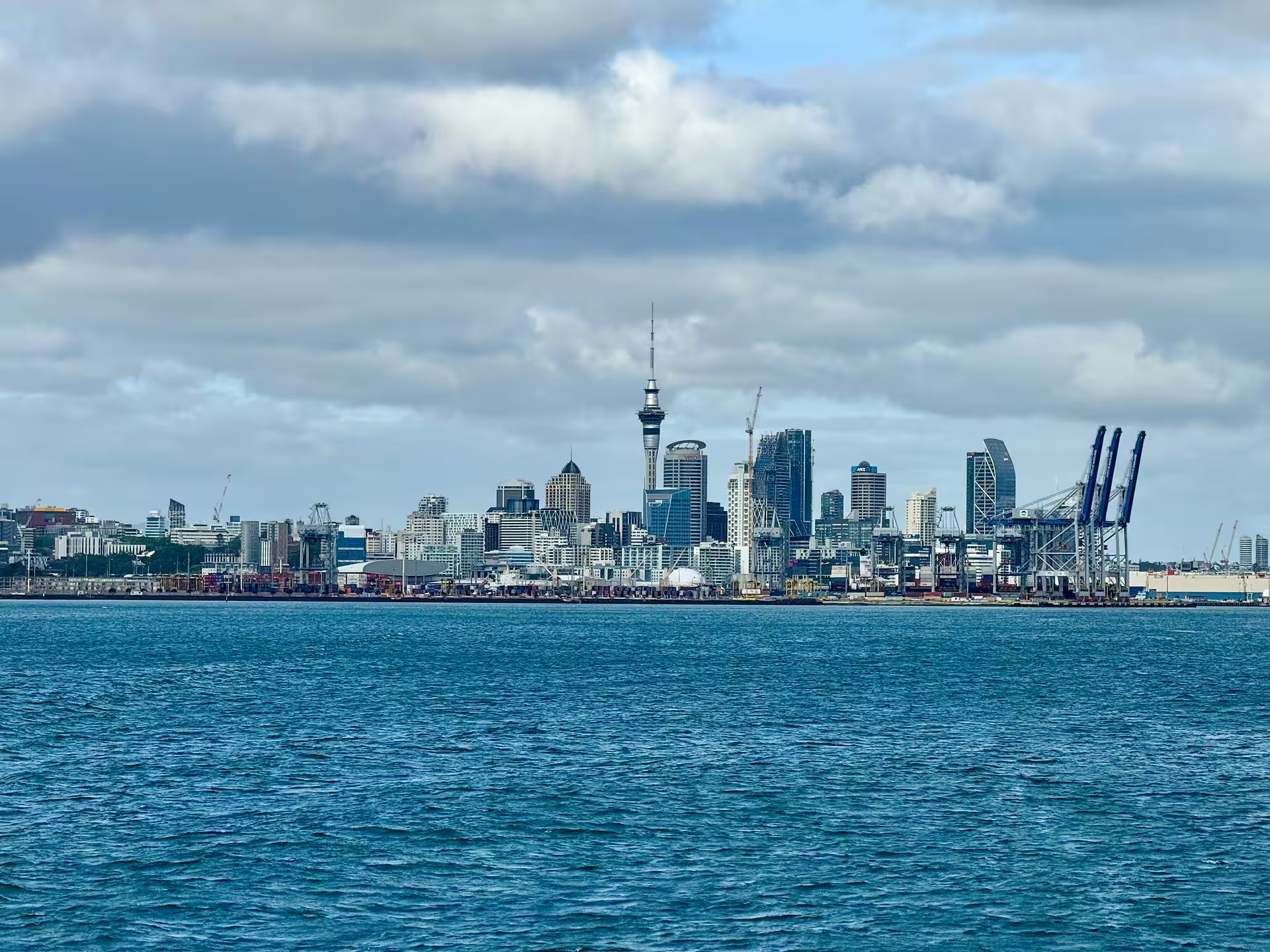
The ferry carried us away from Auckland and out across the Hauraki Gulf. The skyline slowly pulled back behind us, Rangitoto rose across the water, and seabirds began cutting through the wind.

A Fin in the Water
Then a fin appeared in the water.
Not a dolphin fin.
A great white shark.
We only saw it briefly, a dark shape cutting through the surface before disappearing again. After dolphins, seals, sea lions, penguins, jellyfish, an octopus, and glowworms, New Zealand still had one more improbable wildlife encounter waiting offshore.

A Lifer That Wasn't Quite a Lifer
Northern Gannets began passing the ferry in clean white arcs over the water.
Officially, this was my first Northern Gannet of the expedition and the first one I recorded as a birder. But it was not truly my first.
In December 2007, while visiting my parents in New Zealand, we had gone to the gannet colony at Muriwai. I remembered the cliffs and the mass of birds, but I had not appreciated what I was seeing. One of the gannet photographs from that visit became one of only two bird photos I took during the entire trip. The other was a Silver Gull.
Sixteen years later, seeing the birds again felt like meeting something from my own past with completely different eyes. The species had not changed. I had.

Tiritiri Matangi
Tiritiri Matangi did not feel like one more stop added to the end of the itinerary.
It felt like the entire expedition had been preparing us for it.
Ulva had shown us a compact predator-free forest where birds still occupied the center of the world. Kapiti had felt larger and wilder, with more island than we could possibly explore in a few hours. Zealandia had taught us the conservation story behind these sanctuaries and why their fences, monitoring stations, volunteers, and constant work mattered.
Tiritiri somehow gathered all of those lessons into one place.
We decided to take the long way around much of the island, knowing there was no chance of seeing everything in a single day. The route wound through restored forest, coastline, open grassland, wetlands, and eventually to the lighthouse and visitor center. Pōhutukawa trees covered in brilliant red flowers framed the sea and made the island feel like Christmas in summer.
Maybe we were simply lucky. Maybe it was a particularly good day. Or maybe, after nine days of learning New Zealand's birds and their habitats, we were finally no longer overwhelmed by everything around us.
Whatever the reason, Tiritiri Matangi offered the most complete birding experience of the expedition. Even after revisiting so many unforgettable species, our final full day still produced eight lifers—including the North Island Kōkako, one of the birds I had most hoped to see. If someone could visit only one predator-free island in New Zealand, this would be my recommendation.


Everything Showed Up
The remarkable thing was not simply the number of birds.
It was how completely the expedition seemed to come full circle.
Takahē walked through the grass almost within reach. Saddlebacks moved through the forest. Then the Kōkako appeared with its deep blue wattles, one of the birds I had been hoping to see most. Whiteheads, Bellbirds, Fantails, Robins, Tūī, Kererū, and Brown Teal all filled familiar roles in a place that now felt easier to read.
A Little Blue Penguin rested inside a tiny viewing box built into the side of a structure. Sun glare made the window difficult to see through, so we pressed an iPhone against the glass and took the photograph almost blindly. After searching for penguins in the dark on Stewart Island and watching them beside our kayaks in Milford Sound, here was one resting only inches away.
There was even another Wētā waiting inside a wooden viewing box, a callback to the giant insects we had first met at Zealandia.

Hihi Redemption
The Hihi had followed me through the Wellington chapters.
At Zealandia, my first photograph came after dark at a monitoring station, shot at ISO 32,000 and 1/60 second. The next day brought a sharper image, but still at a feeder—and an awkward conversation that taught me more about how I wanted to treat other people than about the bird itself.
Tiritiri finally gave me the redemption I had hoped for.
Hihi began appearing naturally throughout the forest, moving through fern and foliage instead of gathering around a monitoring station. By the end of the day I had photographed both males and females in their own habitat. The photographs were not perfect, but they were the birds in their world, and after everything attached to the earlier encounters, that felt perfect enough.

Takahē, Right There
The first Takahē at Zealandia had felt almost mythical.
It was a bird once believed extinct, suddenly walking through the grass in front of us. Stacy connected with its story immediately, and it became one of her favorite birds of the trip.
On Tiritiri, Takahē were simply there.
That did not make them less special. It made the conservation story more powerful. A bird that had once survived as a tiny hidden population could now stand beside a trail while visitors stopped, smiled, and watched.

Tiritiri Matangi Wildlife Gallery


The GPS Owl
We had chatted with a trio of Polish birders on the ferry, but once we reached the island we each followed our own routes. Near the end of the day, we met again by the wharf and compared sightings.
Then they mentioned a Ruru—a Morepork—and I immediately asked where.
They sent us the exact GPS coordinates, and we headed back into the forest. A local guide confirmed it was somewhere in a particular patch of trees, but somewhere over there was not enough.
A few moments later, our new friends came up behind us. “We have to show you ourselves,” they said. “It is really hard.”
They were not exaggerating. The Ruru was buried deep inside the foliage. From one exact position and one narrow angle, a small opening between leaves revealed part of the owl’s back and patterned feathers. Move even slightly and the bird vanished completely.
It was not the clean owl portrait a photographer dreams about. It was the only possible photograph—and a perfect record of how impossible the bird had been to find.
Earlier in the expedition, my Hihi encounter at Zealandia had left me thinking about the difference between knowing something and helping someone. These birders showed me the better version. They had already found the owl and had nothing to gain by walking back, but they knew we would probably miss it without them.
That was birding at its best: not using what you know to make someone feel small, but using it to help someone see more.

The Final Green Flash
After the Ruru, we all waited near the wharf, watching Brown Teal and letting the final minutes settle.
Then a Red-crowned Parakeet flew in behind us and landed on a bare branch.
Only one of the Polish birders and I saw it arrive.
We glanced at each other in amazement, raised our cameras, and took the shot. Before either of us could say a word to everyone else, it was gone.
The whole encounter lasted only seconds. The bird had landed in open light against a perfectly soft green background, as though the island had staged one final photograph before releasing us back to Auckland.
Sometimes the best photographs are not the ones you plan. They are the ones that appear just long enough to prove the moment really happened.

Celebrating the Entire Year
The ferry ride back to Auckland happened quickly. That was true of the entire expedition. It had been fast, it had been epic, and somehow we were already on our final evening.
Back in Auckland, we traded ferry clothes and camera gear for dinner at the Sky Tower. When the restaurant asked if we were celebrating anything, I smiled and said, “Yes—the entire year.”
They looked a little puzzled, so I explained. We had both turned forty in 2023, and although we were nearly eleven months past it, we were also celebrating our fifteenth wedding anniversary. The timing wasn't exact, but this trip had only been possible because enough pieces had aligned during one remarkable year.
Clouds and fog wrapped around the tower while Auckland glowed below. The restaurant embraced the unusual explanation, bringing us separate birthday and anniversary desserts and turning “the entire year” into a real celebration.
It was a perfect way to spend our final evening in New Zealand, looking out across the city and appreciating everything the journey had already given us.


Auckland Farewell Gallery


The Adventure Was Complete
The next morning, December 11, we returned briefly to the Sky Tower. Daylight revealed the city differently than it had the night before, and after one last look across Auckland, it was time for the airport.
Crossing the International Date Line one final time created one last travel trick. We left New Zealand on December 11 and arrived home on December 11—technically getting back to the USA before the clock said we had left. After nine unforgettable days, the calendar handed one back.
Even now, years later, I'm still amazed by everything that fit into those nine days: Fiordland waterfalls, Milford Sound, penguins beside our kayaks, dolphins, Stewart Island, Ulva, Zealandia, Kapiti, Waitomo, Hobbiton, Tiritiri Matangi, glowworms, a sea lion, seals, jellyfish, an octopus, a great white shark, extraordinary birds, new friends, and more ways to travel than any trip reasonably needed.
The pace still feels almost absurd. But it never felt incomplete. Tiritiri brought the birding story full circle, the Sky Tower brought the personal story full circle, and we were ready to return to our kids, home, and everyday life.
Years later, when FeatherQuest finally found its name and the phrase, "Turn birding into an epic adventure," I realized this was the journey I had been trying to describe all along.
New Zealand didn't just give us unforgettable birds and beautiful places. It showed us how completely birding could blend with travel, photography, wildlife, relationships, curiosity, and wonder.
Some adventures end because the itinerary says it's time to leave. This one ended because it felt complete.
